Proxmox
Prerequisite: Hardware
Once you have your hardware on hand and ready to go, the first thing to do is install Proxmox on it.
Proxmox Virtual Environment (aka Proxmox VE, PVE, or simply Proxmox) is the “bare-metal” OS that you will install directly on your hardware.
It is a free and open-source virtualization platform designed to “sit in-between” your hardware and one or more virtual machines (VMs), and allows for easy management of the VMs running on your server through a web UI that is accessible from any other computer on your home network.
“Why don’t I just install Linux directly and use that instead?”
You can if you want, and that’s totally fine. But using Proxmox as a “base layer” for your server provides much more flexibility for maintenance, experimentation and learning.
This will be the first step in the software part of this journey, so once you have your hardware ready, proceed with the steps below.
Step 1: Prepare installation media
On a personal computer, connect a USB flash drive with at least 4GB of capacity. We will write the installer to this USB drive and then use it to boot the Proxmox installer on your server.
NOTE: Any data currently stored on this USB drive will be destroyed during this process. Always ensure you have any important data backed up somewhere safe.
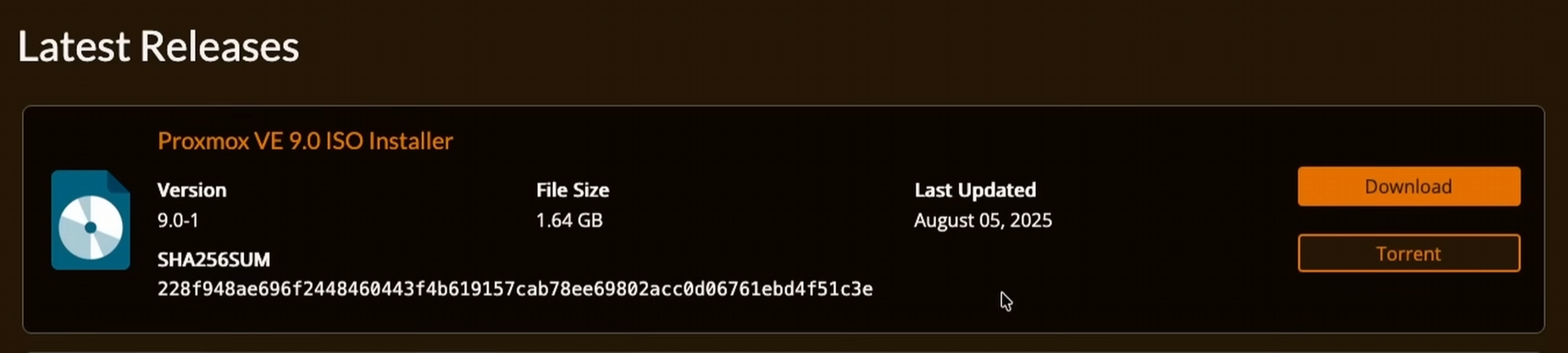
- Navigate here and download the latest version of the Proxmox VE ISO installer:
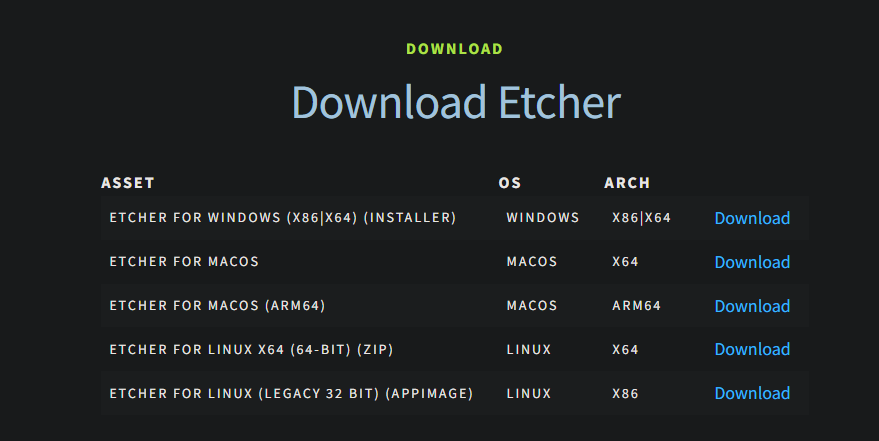
- Navigate here and download Balena Etcher. This is a tool that runs on Windows, macOS and Linux that you will use to write the Proxmox VE ISO installer file to your USB flash drive:
- Run Balena Etcher and choose “Flash from file”, then select the Proxmox VE ISO installer file you downloaded.
- Click “Select target”, check the box for the USB flash drive you have connected (it will usually do this for you automatically), then click “Select 1”.
NOTE: Triple-check you have the correct disk selected, and ONLY that disk. You can unintentionally destroy important data by mistaking one disk for another, or by accidentally selecting multiple disks.
- Click “Flash!”
Once the process is complete, close Balena Etcher, unmount/eject your USB drive, then disconnect it from your computer.
Step 2: Install Proxmox
- Connect the following to your server:
- An ethernet cable connected to your home network (router, etc.)
- A monitor
- A keyboard
- A mouse
- The USB flash drive you flashed earlier
- Power on your server and first go into your BIOS (usually this is achieved by repeatedly pressing the F1, F2 or Delete key when turning on the computer - this varies by manufacturer).
- Once you land in the BIOS, look through the menus and ensure either VT-d (Intel) or SVM (AMD) is enabled, then ensure IOMMU is enabled if possible, and finally, disable Secure Boot.
- Without VT-d or SVM enabled, virtualization will not work at all.
- Enabling IOMMU ensures we can more easily pass through hardware devices like a GPU to a specific VM.
- Leaving Secure Boot enabled can prevent some Linux distributions from booting properly.
- Save your changes to the BIOS and reboot the server.
- Override the boot media by accessing the boot menu after rebooting the server (usually this is achieved by repeatedly pressing the F11 key when turning on the computer, but again this varies by manufacturer), then choose to boot from the USB drive you flashed earlier.
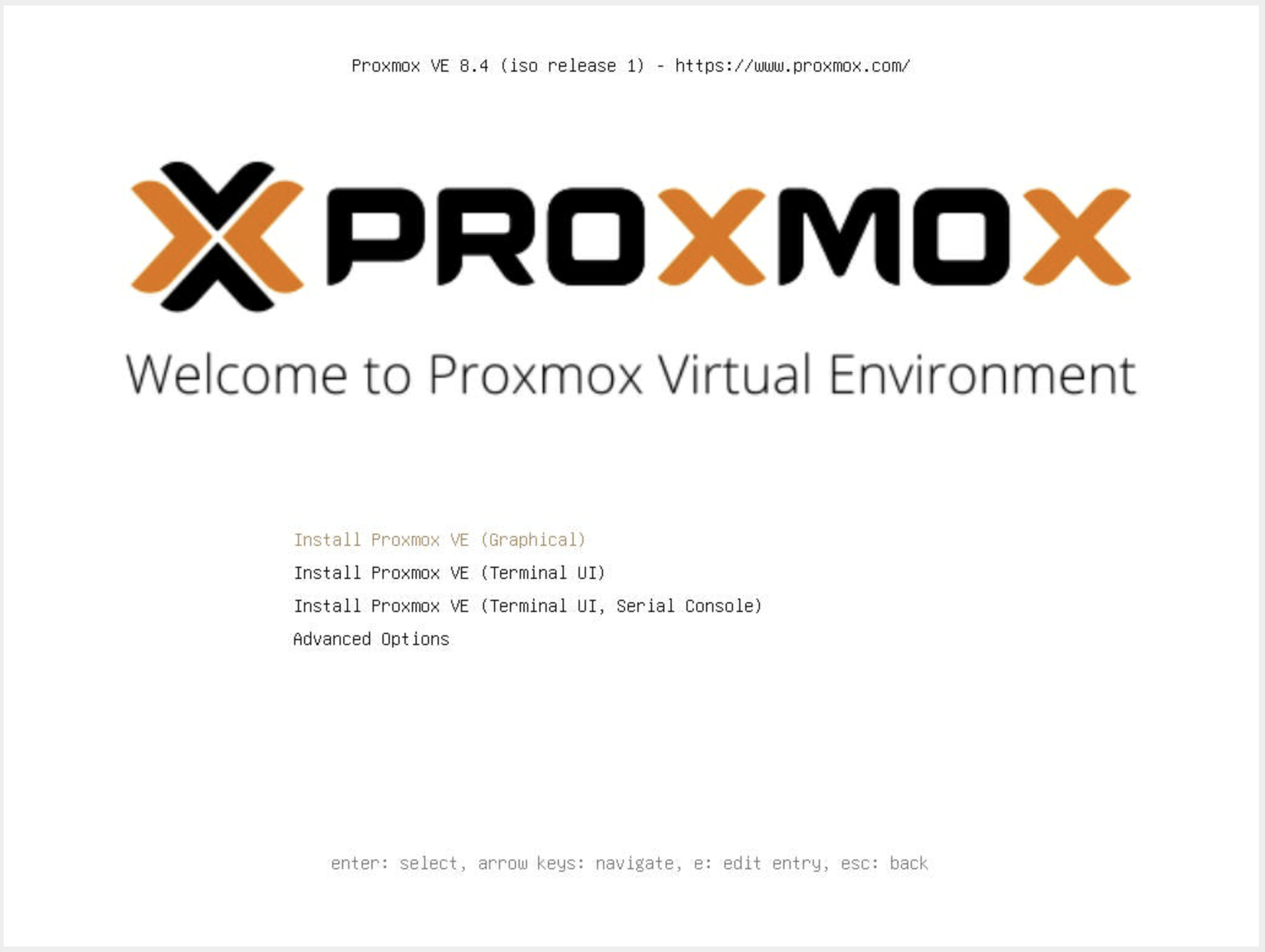
- After booting from the USB drive, choose “Install Proxmox VE (Graphical)”.
- Accept the EULA.
- Choose the target disk to install Proxmox on. You do not want to select a hard drive for this. Install Proxmox to an SSD, ideally a fast NVMe drive. Click “Options” and choose
ext4for your filesystem type.
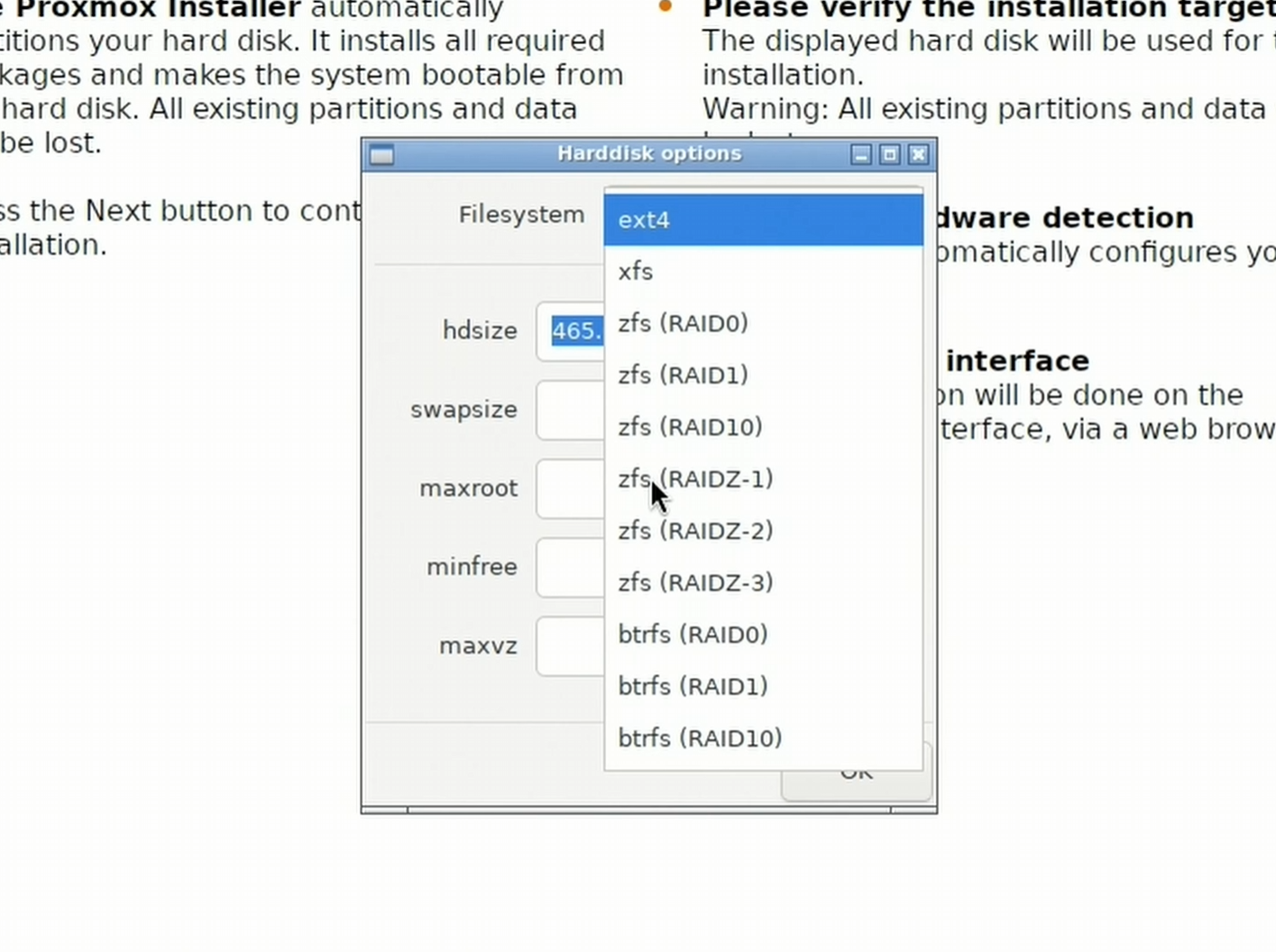
- Optional: If you instead want to use two NVMe drives instead of just one (for redundancy in case one of them fails):
- After clicking “Options”, change the filesystem to “ZFS (RAID1)”.
- Change “Harddisk 0” to the first NVMe drive.
- Change “Harddisk 1” to the second NVMe drive.
- Ensure all other “Harddisk X” choices are set to
-- do not use --. - Click “OK”.
-
Select your country, time zone and keyboard layout, then click “Next”.
-
Create an administrator password (don’t forget it!) and enter your email address, then click “Next”.
-
On the Network Configuration page:

- If your server was able to automatically make a successful connection to your home network via the attached ethernet cable, “Management Interface” should already be chosen for you with a green dot next to the selected interface, leave this alone.
- “Hostname” will default to something like “pve.home.lan” or “pve.lan”, etc. If you want to customize the name of your server, change the “pve” part to something else, or instead just leave it as “pve”.
- “IP Address” should be autopopulated with whatever local IP address your router/DHCP assigned to your server. I recommend changing the last octet to something you’ll remember easily (for example: instead of
10.0.0.246, use10.0.0.20).- Ensure the IP address you are changing this to is not already in use by another device on your network. You can do this on any computer by opening a terminal and typing
ping 10.0.0.20and then hit Enter. If you don’t see any responses to your pings, that IP address is likely available for use.
- Ensure the IP address you are changing this to is not already in use by another device on your network. You can do this on any computer by opening a terminal and typing
- Click “Next”.
-
Review the details on the summary page, and when ready, click “Install”.
-
After the installation is complete, the server will reboot. Remove the USB drive once it reboots so that you don’t accidentally boot back into the Proxmox installer.
-
Once the server has completed rebooting, it should boot automatically into the new Proxmox installation you just created. On the screen, you will only just see white text on a black screen telling you to use a web browser access the server by connecting to the server’s IP address on port 8006 (example:
https://10.0.0.20:8006) -
Congrats! The foundation of your server is now up and running. You can disconnect everything from the server except for the power cable and the ethernet cable, since from this point forward you will manage everything using your personal computer instead.
Step 3: Proxmox Configuration
- On your personal computer, open a web browser and navigate to port 8006 on your server’s IP address (example:
https://10.0.0.20:8006)- You will likely get a warning from your browser stating that the website is not secure. This is because the server’s web interface is served over HTTPS, but only has a self-signed certificate for this connection. This is expected and is nothing to worry about. Simply proceed by clicking “Advanced” and “Proceed to website” (this process varies depending on what browser you are using).

- You will likely get a warning from your browser stating that the website is not secure. This is because the server’s web interface is served over HTTPS, but only has a self-signed certificate for this connection. This is expected and is nothing to worry about. Simply proceed by clicking “Advanced” and “Proceed to website” (this process varies depending on what browser you are using).
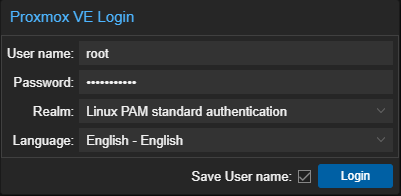
- Log into the web interface by entering the username “root”, along with the password you set during the installation process.
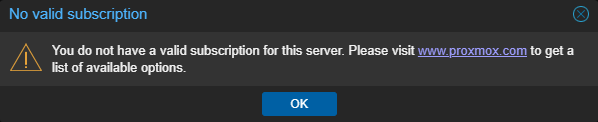
- The first thing you will see is a warning message stating that you do not have a valid subscription for your server. This is expected since we are using Proxmox for personal use and don’t have an enterprise subscription. Simply ignore this message and click OK for now, we will disable this message later.
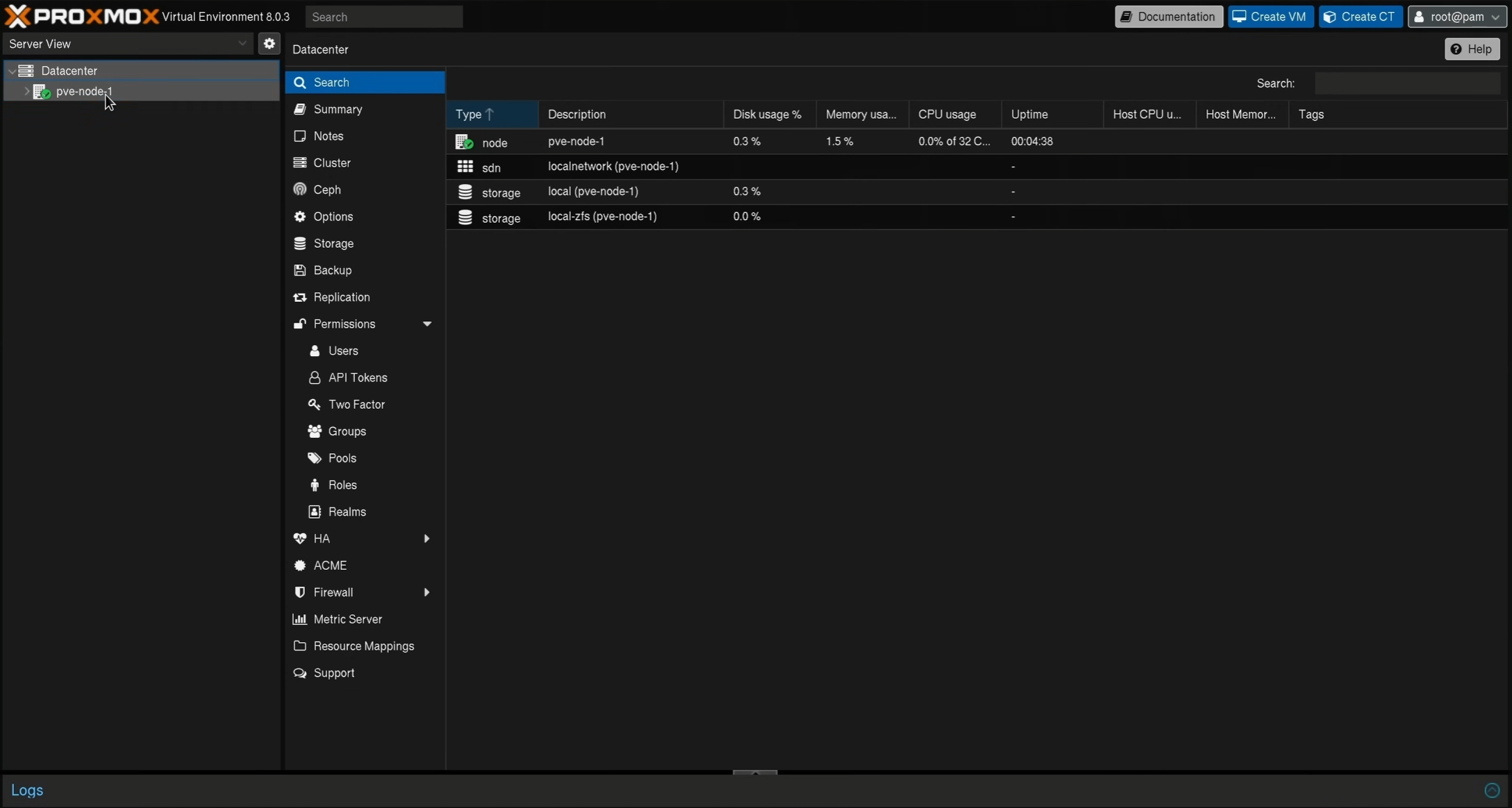
- You are now logged into the Proxmox VE web UI for your server.
- The first thing we will do here is set up our package repositories correctly so that we can successfully update Proxmox. It’s a good idea to update Proxmox periodically, every week or two is usually often enough.
- In the sidebar on the left, you will see the top level is named “Datacenter”. The datacenter can contain multiple Proxmox servers grouped together, this makes a “cluster”, where each server is a “node” (this is outside of the scope of this guide, in which we will only have a single Proxmox server).
- Under “Datacenter”, you should see a single node listed with the hostname you chose during the installation process (in the example below, it is “forge”)